Vatican Museums Tickets: How to Visit the Vatican and St. Peter’s

The Vatican is the most visited site in Rome — and one of the most misunderstood to navigate. Buy your Vatican Museums tickets at the official portal, tickets.museivaticani.va, book as early as 60 days out, and go on a Tuesday morning. Every standard ticket covers the Museums and the Sistine Chapel. St. Peter’s Basilica is free. This guide is for anyone planning a Vatican visit who wants the real mechanics — not a reseller upsell.
If you’re building a full Rome schedule around this, the 3 days in Rome itinerary will help you place the Vatican in context.
Ticket Options at a Glance
| Ticket / Option | What’s Included | Rough Price (as of 2026) | Best For |
|---|---|---|---|
| Standard full entry (walk-in) | Museums + Sistine Chapel | Around €20 | If you somehow arrive without booking |
| Standard full entry (online, skip-the-line) | Museums + Sistine Chapel + reserved entry slot | Around €25 (€20 + €5 booking fee) | Most independent visitors |
| Reduced entry (students, pilgrims, etc.) | Same as standard | Around €10–15 + €5 fee | Eligible groups |
| Last Sunday of the month | Museums + Sistine Chapel | Free | Budget travelers willing to queue |
| Official guided tour (Vatican) | Museums + Sistine Chapel, max 10 pax | From around €20 + ticket | First-timers wanting context |
| Early-entry / small group tour (third-party) | Museums + Sistine before crowds | From around €60–100+ | Anyone wanting the Sistine quiet |
| Vatican Gardens add-on | Gardens only (separate ticket) | Around €35 | Garden lovers |
| St. Peter’s Basilica (main floor) | Interior, Vatican Grottoes | Free | Everyone |
| St. Peter’s dome climb (lift) | Roof terrace + 320 steps to lantern | Around €10 | Views, stamina |
| St. Peter’s dome climb (stairs only) | 551 steps from bottom | Around €8 | The committed |
All prices are approximate and subject to change — always verify current rates at the official ticket site before booking.
Vatican Museums Tickets: Where to Buy and How It Works
The single correct URL is tickets.museivaticani.va. That is it. Not museivaticani-tickets.com, not vaticanmuseum.co, not the dozens of sites that rank on Google by mimicking the Vatican’s branding. The official Vatican Museums website itself posts a notice warning visitors about lookalike domains charging significantly higher prices. Screenshot it before you book so you’re certain you’re in the right place.
The booking process
You land on the portal, select “Museums and Collections,” choose your date and preferred time slot (slots open every 30 minutes from 8:00 am), select the ticket category, confirm the number of visitors, and pay. You will receive a QR code by email. You do not need to print it — show it on your phone at the access corridors in the entrance hall, where staff will validate it before you hit the turnstiles. Skip the validation step and your ticket will not work.
Tickets are non-refundable, so check your dates carefully before paying.
When tickets become available — and when they sell out
The official site releases slots 60 days in advance. In summer (June through September), weekday mornings fill up three to four weeks out. In spring (April and May, particularly around Easter), slots can disappear even faster. If you’re visiting during Jubilee year events or a major Catholic feast day, check the Vatican’s calendar of openings and closures — the Museums sometimes close or run reduced hours.
One thing many guides do not mention: the official site often releases a small tranche of same-day or next-day tickets late in the afternoon. If you’ve arrived in Rome without a booking, check the portal at around 4–5 pm the afternoon before your target date. It is not guaranteed, but it is a real pattern that regular visitors use.
Walk-up tickets at the door no longer exist. You must book online.
What your ticket includes
A standard Vatican Museums ticket (around €25 online as of 2026) gives you:
- All the permanent galleries of the Vatican Museums complex — the Pio Clementino Museum with its ancient sculptures, the Gallery of Maps, the Raphael Rooms, the Borgia Apartments, the Gallery of Tapestries, and more
- The Sistine Chapel — there is no separate Sistine Chapel ticket; it is always part of the Museums entry
- The Pinacoteca (Vatican picture gallery)
- The Collection of Modern and Contemporary Art
It does not include: the Vatican Gardens (separate ticket, around €35), the Necropolis beneath St. Peter’s (the Scavi — separate reservation entirely, managed by a different office), or the dome climb.
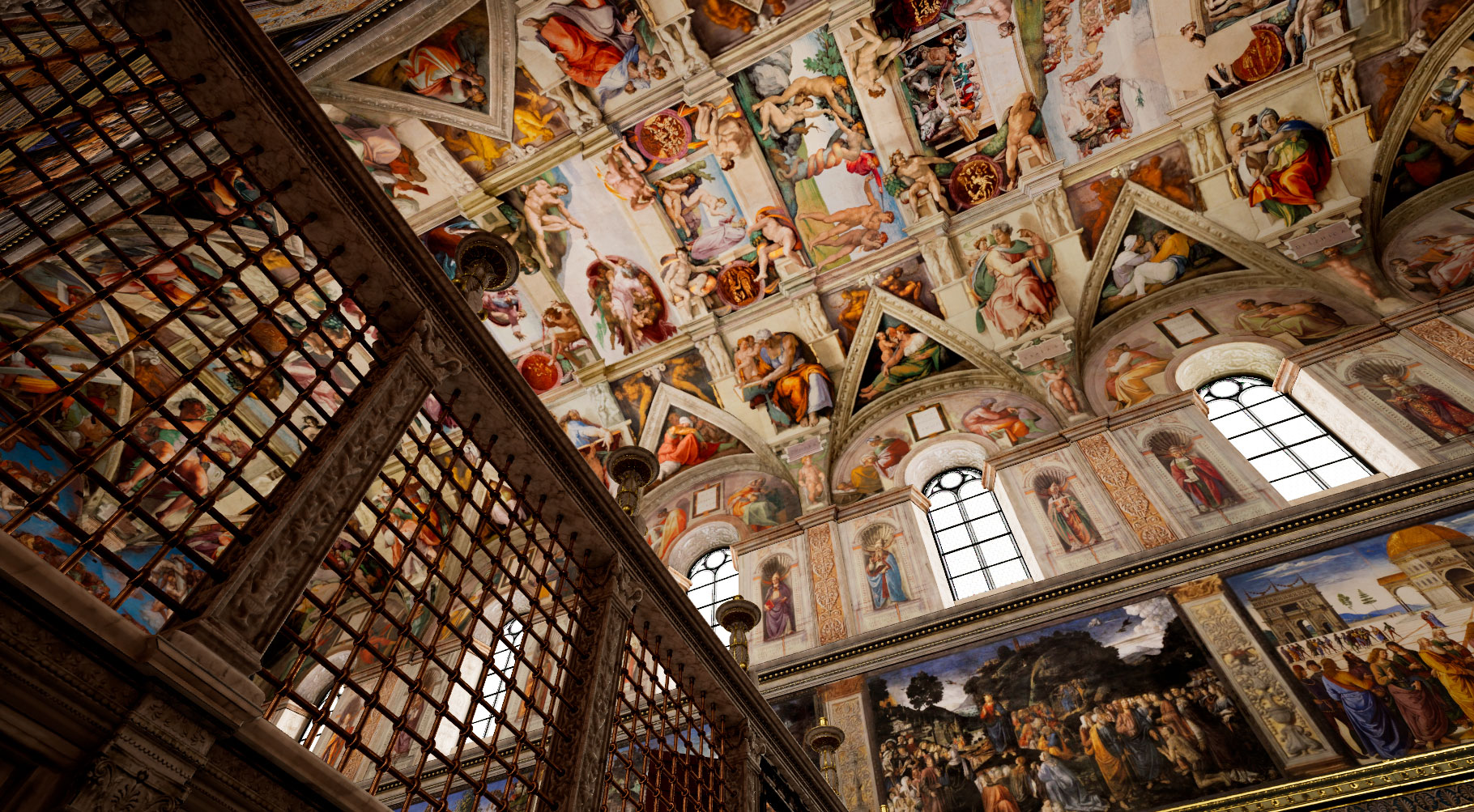
The Sistine Chapel: What to Actually Expect Inside
The Sistine Chapel is the emotional peak of the entire visit, and it is also the room where the gap between expectation and reality hits hardest — in both directions.
The ceiling is overwhelming. Michelangelo painted it between 1508 and 1512, lying on scaffolding, and the result — nine scenes from Genesis flanked by prophets and sibyls, crowned by the famous Creation of Adam — covers 500 square metres directly above your head. You will crane your neck and your eyes will not know where to land first. The Last Judgement fills the entire altar wall; it was added between 1536 and 1541, and it is rawer, more violent, and more personal than the ceiling.
What surprises people: the room itself is fairly small. It fits around 200 visitors at capacity. At peak times — mid-morning in summer — it can feel suffocating. Guards are stationed at the door and throughout, and they are serious about silence and the photography ban. No photography means no photography. Not even quick phone shots. The guards will ask you to put your device away.
How long you need: most visitors spend 15–30 minutes inside the Chapel. Budget two to three hours minimum for the walk from the entrance through the galleries to reach it — the route is around four kilometres if you follow it in full.
The Sistine Chapel restoration notice
From February 2026, the Vatican began restoration work on the altar wall of the Sistine Chapel. The scaffolding came down on 26 March 2026 and the chapel remained open throughout. As with any major heritage site, targeted conservation work can begin again with limited notice — check current status on the official site before your visit.
St. Peter’s Basilica: Free, Mandatory, and Worth Every Minute
St. Peter’s Basilica is one of the few major headline sights in Rome where the front door is still free. No ticket. No booking. You walk up to St. Peter’s Square, join the security queue, and go in.
That security queue is not nothing. In peak season — April through October — waits of 45 minutes to an hour are common. On major Catholic feast days or during papal audiences (held most Wednesdays in the square), the queue can stretch for two hours. Arrive early, aim for 8:00 am or just after, or come late afternoon when the cruise-group rush has usually passed.
What is free inside
The main floor of the basilica is free and extraordinary: Michelangelo’s Pietà behind glass near the entrance, Bernini’s 29-metre bronze canopy (baldacchino) over the main altar, the papal tombs in the Vatican Grottoes accessible via a stairway inside, and the treasury (Tesoro di San Pietro). All free.
The dome climb
Climbing the dome is the one paid component. As of 2026:
- Lift to roof terrace + 320 stairs to the lantern at the top: around €10
- Stairs only (551 steps from ground level): around €8
The lift takes you to the roof terrace, where you can walk around the outside of the dome and look across Rome. From there you must still climb those 320 narrow, increasingly steep, slightly vertiginous steps through the double shell of the dome itself to reach the lantern. It is worth it. The view from the top — Rome spreading out in every direction, the Vatican Gardens below, the Tiber curling west — is one of the best in the city.
The dome opens at 7:30 am and closes one hour before the basilica. Go early.
Dress code — and why it actually matters
The dress code at St. Peter’s is enforced at the security checkpoint. Guards will turn you away. They do not make exceptions for foreign visitors, children, heat, or creative interpretations of “covered.” The rules are specific:
- Shoulders must be covered. No tank tops, spaghetti straps, or bare shoulders. A scarf or cardigan draped over is acceptable.
- Knees must be covered. Shorts above the knee, short skirts, and ripped jeans with visible thigh will get you stopped. Mid-length shorts that hit the knee are generally fine.
- No hats worn indoors. Men in particular will be asked to remove caps at the threshold.
The dress code applies to the Vatican Museums too, though enforcement there is slightly less rigorous than at the basilica door.
Pack a light scarf if you’re visiting in summer. It weighs nothing in a bag and solves the problem entirely.
The Museums-to-Basilica Shortcut: Real, Useful, and Unreliable
Inside the Sistine Chapel, on the right-hand side as you face the altar, there is a door. That door is a direct passage into St. Peter’s Basilica, bypassing the main Museums exit and most of the walk across St. Peter’s Square. When it works, it deposits you right at the side security entrance to the basilica, saving 20 to 30 minutes of walking and queue time.
When it works is the key phrase. Access through this passage has become progressively less predictable. It is closed on Wednesdays (papal audience day) without exception. Outside that, availability depends on staffing, crowd volume, and what the Vatican decides on any given day. Some guided tours have historically been able to use it more reliably than independent visitors, but even that has become inconsistent.
The honest advice: treat the shortcut as a potential bonus, not a plan. Exit through the Museums normally, walk around the colonnade into St. Peter’s Square, and join the standard queue. Build that time into your schedule. If the door is open when you reach it, use it — but do not organise your whole morning around it.
Tours vs. Going It Alone
Whether a guided tour is worth it comes down to one question: do you want to understand what you’re looking at?
The Vatican Museums contain around 70,000 works. Most of the galleries have minimal signage in English. Walking through without context, you will see beautiful things and absorb almost none of the layering — the political messages, the personal stories of the artists, the centuries of accumulation. A good guide changes the visit completely.
That said, the official Vatican-run guided tours (max 10 people, two hours, from around €20 plus ticket as of 2026) are decent but limited in scope. Independent tour companies — Through Eternity, LivTours, Walks of Italy, Context Travel — tend to offer more depth, smaller groups, and often better access to the early-entry slots.
Early-entry tours
Several licensed operators offer access before the Museums open to general public ticket holders. These tours typically start at 8:00 am and get you into the Sistine Chapel with significantly fewer people inside. The effect is not a small thing. Standing in the Sistine Chapel with 30 people rather than 200 changes the experience of looking at the ceiling. The premium is real — expect to pay around €60–100 per person and up — but for many visitors it is the best money they spend in Rome.
One important note on marketing language: the Vatican’s opening time is 8:00 am, so no tour can offer access before the building opens. What these “early access” or “first entry” tours give you is a spot in the first wave through the door at 8:00 am and a knowledgeable guide who moves efficiently to get you to the Sistine before the mid-morning crowd arrives.
If you prefer DIY, book the earliest available slot (8:00 am) on the official site and walk directly to the Sistine Chapel first. Do not browse the galleries on the way in. You can explore everything else on the way back out.
Opening Hours and Best Times to Visit
Standard hours (Monday to Saturday): 8:00 am to 8:00 pm. Last entry at 6:00 pm.
Last Sunday of the month: 9:00 am to 2:00 pm (last entry 12:30 pm). Free admission.
The Museums are closed every other Sunday of the month. They are also closed on Catholic feast days and various other dates — check the official calendar before travelling.
When to go
Tuesday morning, first slot: consistently the quietest weekday. The weekend surge has passed and Wednesday papal audiences have not yet drawn the pilgrimage crowds.
August midday: counterintuitively, a lull exists in August when tour group numbers ease slightly — but this is not reliable and the heat inside is significant.
Avoid:
– Last Sunday of the month (free admission brings enormous queues that negate any financial saving)
– Holy Week and Easter (the city is at its most crowded and the Vatican is central to every event)
– Wednesdays (papal audience in St. Peter’s Square creates a secondary wave of visitors)
– Mid-morning on any summer Saturday
The best time to visit Italy piece goes into seasonal patterns in more depth if you’re still deciding when to travel.
Accessibility
The Vatican Museums and St. Peter’s Basilica have made genuine efforts on accessibility, though the site’s age creates limitations.
Vatican Museums:
– Visitors with a certified disability of at least 67% enter free. Bring documentation or a European Disability Card. Free tickets for disabled visitors and one companion cannot be booked online — go to the Special Permits or Welcome Desk at the entrance.
– Disabled visitors and their companions receive priority skip-the-line entry.
– Wheelchairs and pushchairs can access the main galleries. Some areas involve stairs or uneven surfaces.
– Request accessibility information directly at [email protected] before your visit.
St. Peter’s Basilica:
– Wheelchair access is available to the main floor.
– The dome climb is not accessible to wheelchair users.
– The lift to the roof terrace is narrow and best confirmed directly with the basilica in advance.
Reseller Scams: How to Spot Them and Why They’re Everywhere
A significant portion of the first page of Google for “Vatican Museums tickets” is reseller sites — not scams in the sense of disappearing with your money, but unofficial sellers charging substantially more than the official price. Some genuine scam sites exist too, with names like museivaticanitickets.com, vatican-museums.com, and others that mimic the official domain.
Here is the architecture of the problem. The official price for a skip-the-line ticket is around €25 (€20 + €5 booking fee). Some reseller sites charge €35–50 for what is effectively the same timed-entry ticket. They are legally purchasing real tickets and marking them up — which is not illegal, but it is not a good use of your money.
Actual scam sites — the ones to avoid entirely — typically do several things: they use domain names very close to the official Vatican address, they do not show a booking fee breakdown, and they charge two to three times the official rate. The Vatican Museums’ own site explicitly warns about this.
How to stay safe:
1. The only official booking URL is tickets.museivaticani.va. Look for that exact domain in your browser’s address bar.
2. Legitimate third-party platforms that are official partners include GetYourGuide, Tiqets, and Viator. They will charge a small premium over the official price, but they are real and have functioning customer service.
3. If you find a Vatican ticket offer through a social media ad, a pop-up, or an email, treat it with suspicion regardless of how professional it looks.
4. The Vatican will never send you unsolicited email ticket offers.
If you’re thinking through other common pitfalls for Italy visitors, the piece on Italy travel mistakes covers several of the same booking patterns across different sites.
Final Thoughts
The Vatican is one of the genuinely non-negotiable experiences in Rome — not because it is on every tourist list, but because the density of extraordinary things in one building is almost unreasonable. Michelangelo’s ceiling, Raphael’s Rooms, the Laocoön statue, the Gallery of Maps, and St. Peter’s Basilica all in one morning is a lot to absorb. Go with a plan: book your Vatican Museums tickets early at the official site, arrive at 8:00 am, head to the Sistine Chapel first, then work back through the galleries on your way out. Give the basilica its own unhurried hour in the afternoon.
For the broader Rome picture, the guide to visiting Rome is a good place to start, and the Colosseum tickets guide covers the other major pre-booking requirement in the city. If you are planning your whole trip from scratch, the Italy trip planner and the Italy travel guide will help you fit the Vatican into the larger shape of your trip.
Questions travellers ask
Do I need a separate ticket for the Sistine Chapel?
No. There is no standalone Sistine Chapel ticket. The chapel is inside the Vatican Museums complex and is included with every standard Museums entry. If someone is selling you a “Sistine Chapel ticket” as a separate product, they are either selling you a guided tour (which is fine) or misleading you. Buy your ticket at tickets.museivaticani.va and the Sistine Chapel is included.
Can I visit St. Peter’s Basilica with my Vatican Museums ticket?
No — but you do not need to. St. Peter’s Basilica is free to enter and has no ticketing system. After you finish the Museums, you walk around to St. Peter’s Square and join the free security queue. The only paid components at the basilica are the dome climb (around €8–10 as of 2026) and the Scavi (the underground Necropolis), which requires a separate advance reservation through the Excavations Office.
How far in advance should I book Vatican Museums tickets?
Book as soon as you know your dates. Tickets go on sale 60 days in advance on the official site. In peak season (April–September), popular morning slots sell out three to four weeks ahead. During Holy Week and major Catholic events, they can be gone within days of release. If you’re travelling in the quieter months (November–February), you may find slots available a week or two out, but there is no reason to take the risk. Book early.
Is photography allowed in the Sistine Chapel?
No. Photography is completely prohibited inside the Sistine Chapel — not just flash photography, but all photography, including phone cameras. Guards enforce this actively. The rule exists partly for conservation reasons and partly out of respect for the religious function of the space. You can photograph freely in most of the other Museums galleries.
What happens if I arrive without the right clothes?
You will be turned away at the security checkpoint, both at the Vatican Museums entrance and at St. Peter’s Basilica. Neither site makes exceptions. The fix is simple: shoulders and knees covered. In summer, carry a light scarf or a second layer in your bag. Large scarves are also sold by vendors in the square, but at inflated prices.
Is the last Sunday of the month worth it for free entry?
In almost every case, no. Free Sundays draw enormous crowds — the queue begins forming well before 9:00 am and the Museums and Sistine Chapel feel genuinely unpleasant by mid-morning. The €25 you save is not worth several hours of your trip. The exception might be if you’re on a very tight budget and are willing to queue from 7:30 am to be near the front.
Can I do the Vatican in half a day?
The Museums alone, done at a reasonable pace and including the Sistine Chapel, take two to three hours minimum. Add St. Peter’s Basilica and the dome climb and you are looking at a full day — four to six hours total, depending on how long you spend in each space. Trying to rush it produces a frustrating, fragmentary experience. Give the Vatican a full morning starting at 8:00 am, with the afternoon free for the nearby things to do in Rome that are less physically demanding.
Are there toilets and places to eat inside?
Yes. The Vatican Museums have cafeterias, a rooftop restaurant, and multiple restroom facilities at intervals throughout the complex. Prices inside are higher than the city average. There is also a small café on the roof terrace of St. Peter’s. If you are doing a morning visit, eat breakfast before you arrive — the first cafeteria is not until you’re well into the Museums route.